
Two Upshur County Release Clocks
Do not apply a TDCJ calculation to a short Upshur County jail stay. County release can turn on bond, a court order, dismissal, sentence credit, a local sentence, or transfer. The Sheriff does not publish a projected-date calculator or a verified local good-time policy. For that path, the judgment, jail-credit calculation, current custody answer, and book-out sheet are the relevant records.
A TDCJ Projected Release Date begins only after state intake. TDCJ’s Classification and Records Office calculates it under the sentence, offense date, offense title, credits, eligibility law, and Board action. A person waiting for trial has no sentence endpoint to project. A person serving a county sentence may have a calculable term, but the public state field does not control it.
Find an Upshur County Release Date
Begin with custody class, then record the exact label attached to every date. A number copied without its label can turn parole eligibility into a promised release or confuse maximum expiration with a scheduled exit.
- Confirm whether the person is at the Upshur County Jail, in TDCJ custody, on state supervision, or held elsewhere.
- For TDCJ, search the official offender form. Use the seven-digit TDCJ number or SID when available; otherwise search by name and supported refinements.
- Open the matching record. Compare birth date, conviction county, offense, offense date, sentence, and identifiers before using any date.
- Transcribe both the date and its label: Projected Release, Parole Eligibility, Maximum Sentence, Next Review, or Scheduled Release.
- Check Parole Review Information. Approval, denial, program placement, and later review can change the practical path.
- For an Upshur jail sentence, request the judgment, commitment, jail-credit calculation, and booking/release sheet. Ask which written policy controls any local credit.
- Recheck near the date and obtain direct confirmation. Holds, court action, auditing, or transfer can change the result.
The official TDCJ form shown below is the state route, not a county jail roster. Visit the linked form before using the screenshot because the live fields and record can change.
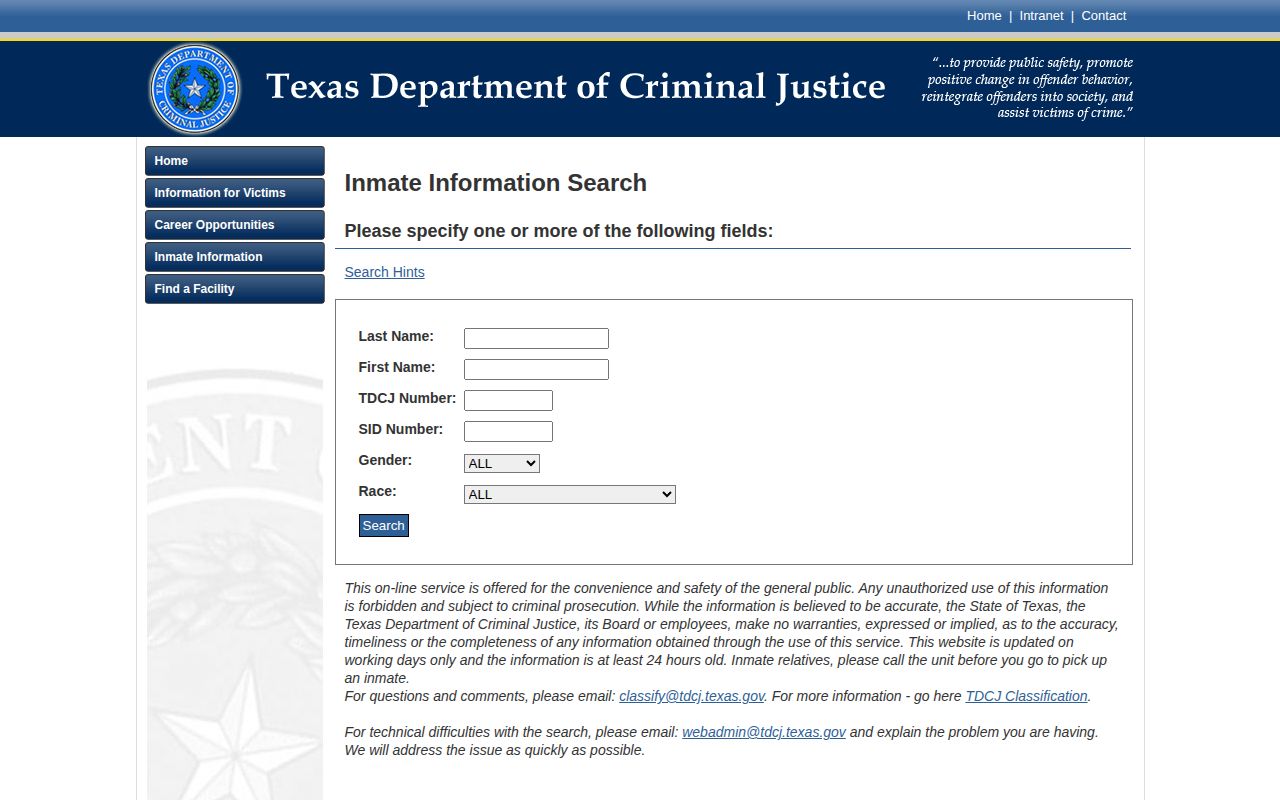
The image shows where a Texas state search begins. It does not establish an Upshur County jail date or confirm that a scheduled release occurred.
Upshur County Release Date Labels
TDCJ uses several labels because each answers a separate question. Read them in the context of the sentence and current status. The release-date record can change as the case moves from eligibility through Board review and final processing.
| Date label | What it means | What it does not prove |
|---|---|---|
| Projected Release Date | TDCJ’s calculated date for leaving incarceration if parole does not occur sooner | A guaranteed departure on that day |
| Parole Eligibility Date | The first date the case may qualify for parole consideration under the governing rule | Approval or physical release |
| Next Review Date | A future point for another Board review after a result | A release appointment |
| Scheduled Release | A date assigned after approval and release processing advances | Completion of every audit, program, residence, or hold check |
| Maximum Sentence Date | The sentence endpoint absent earlier lawful release or another controlling change | That no other case, detainer, or sentence exists |
| Actual release date | The date physical custody ended in the agency record | That the person entered the community rather than another custodian |
Written Upshur County Date Requests
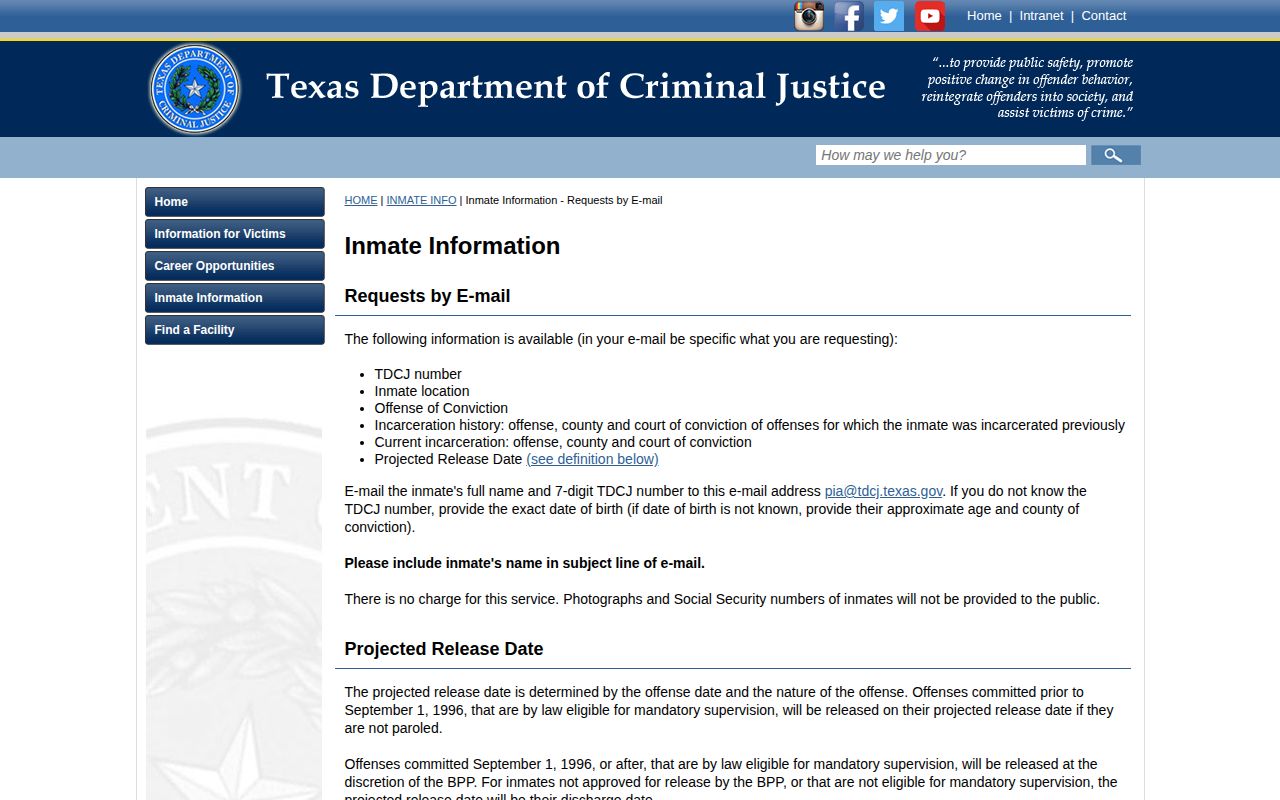
A fully discharged person may not remain in TDCJ’s live public search. TDCJ also offers a no-charge inmate-information email route at pia@tdcj.texas.gov. Include full name and the seven-digit TDCJ number. If the number is unknown, give the exact birth date or approximate age and the county of conviction. TDCJ lists projected release date, parole eligibility, current and prior incarceration, offense, court, county, and location among available facts.
The official email information page explains those request fields and the conditional projected-date definition. Its captured view appears below.
For a county case, direct the request elsewhere. The Upshur County Sheriff can address jail custody and book-out records, while the proper clerk holds the judgment and later court orders. The District Clerk is the custodian for felony cases. County-level cases use the County Clerk’s date-bounded court portals. Ask for existing records, not a new date calculation the office does not maintain.
Texas Good Time for Upshur Cases
Texas Government Code §498.003 calls good-conduct time a privilege, not a right. TDCJ may award it based on classification, conduct, and qualifying participation, and may forfeit it for misconduct. Subsection (d) allows up to 15 days for each 30 days actually served for diligent participation in qualifying programs. Subsection (e) addresses qualifying county-jail work or time certification. These credits can affect classification and calculations where the law permits. They do not rewrite the court’s sentence and never guarantee a release day.
Mandatory-supervision rules also depend on offense date. For eligible offenses before September 1, 1996, flat time plus good time reaching the sentence can establish a projected mandatory-supervision date if parole has not happened first. For eligible offenses on or after that date, mandatory supervision is discretionary and needs Board approval. A denial may move the projection to maximum expiration or discharge. Later approval can move it forward to allow processing. Government Code §508.149 excludes listed categories.
No public Upshur Sheriff policy was found that permits a reliable local good-time calculation. Request the commitment, judgment, jail-credit record, book-out sheet, and any written policy the jail applies. Weekends and holidays can affect administration, but the research found no local rule for an early weekend release and no stated release hour. None should be assumed.
No Texas 85 Percent Rule
Texas has no general rule requiring every prisoner to serve about 85 percent. That figure is often borrowed from a different federal calculation. It should not be used to estimate a TDCJ or Upshur County date.
Government Code §508.145(d) applies a different rule to specified Article 42A.054 offenses and applicable deadly-weapon findings. Parole eligibility generally requires actual calendar time, with good time excluded, equal to one-half of the sentence or 30 calendar years, whichever is less, subject to the full offense-specific statute. One-half is 50 percent, not 85 percent. Other subsections govern other offense classes, dates, life sentences, and enhancements. Read the judgment and offense date before applying any rule.
Eligibility is only the first point for consideration. It does not book a hearing or promise release. The Texas Board of Pardons and Paroles reviews files and votes. A denial can set a later review, while approval can require a program, residence plan, or more processing.
What Changes Upshur Release Dates
A projected or scheduled date can move for legal, administrative, and custody reasons. The correct response is to trace the new entry, not to assume the first date was false.
| Change | Possible effect | Record to check |
|---|---|---|
| Good-time award or forfeiture | Changes an eligible state calculation | TDCJ classification and records information |
| Parole vote | May create an earlier route, later review, or program condition | Parole Review Information and Board result |
| Mandatory-supervision eligibility | Can set projection at mandatory release or maximum expiration | Offense date, §508.149, and TDCJ detail |
| New court order or sentence correction | Changes the legal term or custody authority | Signed court order and corrected commitment |
| Detainer or receiving agency | Ends one custody but may cause transfer instead of community release | Release disposition and receiving system |
| Program or residence approval | Can delay execution after a favorable decision | TDCJ release processing status |
| Audit or recalculation | Moves even a posted scheduled date | Fresh TDCJ confirmation |
TDCJ’s Ombudsman materials say release certificates are processed, audited, and calculated. Program-completion cases often take about four to six weeks depending on complete information and an approved residence. The posted date may change without notice, even on the scheduled day. That range explains an operational process; it is not a timetable promised for each person.
Confirm Upshur County Actual Release
An actual release record should state when custody ended and whether the person entered the community or went to another custodian. “Released to TDCJ,” an ICE transfer, and a bond release all end Upshur jail custody, but only one necessarily reflects the same post-custody path. Obtain the book-out sheet or TDCJ status and compare it with the court docket.
Near an expected state date, recheck TDCJ and look for the exact Scheduled Release label and location. For future custody-change alerts, the VINE Inmate Check page explains Texas IVSS-Counties and its limits. Notification is a prompt to verify, not the certified release instrument. For a county case, call the jail and request a written release date, time, disposition, and receiving agency when relevant.
Dates deserve two-source confirmation. A calculated field explains what may happen. The holding agency’s completed release entry explains what did happen.
When records conflict, compare their update times and the authority behind each one. A court judgment sets the sentence, but it may predate a later correction or revocation. A TDCJ detail reflects the state calculation, yet it can change during an audit. The Upshur jail records physical custody, though a release-to-agency entry may require a second search to learn where the person went. Preserve each label, date, and source instead of blending them into one timeline. For an important historical question, request the written state or jail record and the filed court order. That set can show the sentence, credits, custody endpoint, destination, and later supervision without treating a former projection as the final event.